
AI vs. Manual UX Personalization: Comparison
Compare AI-driven and manual UX personalization—trade-offs in speed, cost, scalability, creativity, and when to use or combine each approach.

Personalizing user experiences is no longer optional - it's expected. But how should you approach it? There are two main methods: AI-driven personalization and manual personalization. Each has its strengths and weaknesses, and the choice depends on your goals, resources, and audience.
- AI-driven personalization uses machine learning to analyze user behavior and deliver tailored content in real time. It's fast, scalable, and data-driven, making it ideal for high-volume environments like e-commerce or streaming platforms. However, it requires significant upfront investment and can lack emotional depth or nuanced decision-making.
- Manual personalization relies on human designers to craft tailored experiences based on user research and segmentation. It excels in high-stakes scenarios, like B2B sales or regulated industries, where precision and emotional understanding are critical. But it’s time-intensive and less efficient for large-scale applications.
Quick takeaway: AI handles large-scale, data-heavy tasks efficiently, while manual methods provide a human touch for more precise, relationship-focused personalization. Many businesses now combine both approaches to balance speed and quality.
Quick Comparison
| Factor | AI-Driven Personalization | Manual Personalization |
|---|---|---|
| Speed | Seconds to minutes | Hours to days |
| Scalability | Handles thousands of segments | Limited by human capacity |
| Cost | High upfront, low per-unit | Low upfront, high ongoing labor |
| Data Handling | Automated real-time analysis | Manual extraction and analysis |
| Creative Input | Limited emotional nuance | Strong emotional and contextual fit |
| Best For | High-volume, fast-paced industries | High-stakes, relationship-driven industries |
Blending both methods can maximize efficiency while maintaining a personal touch. AI takes care of repetitive tasks, while human designers focus on areas requiring emotional intelligence and brand alignment.
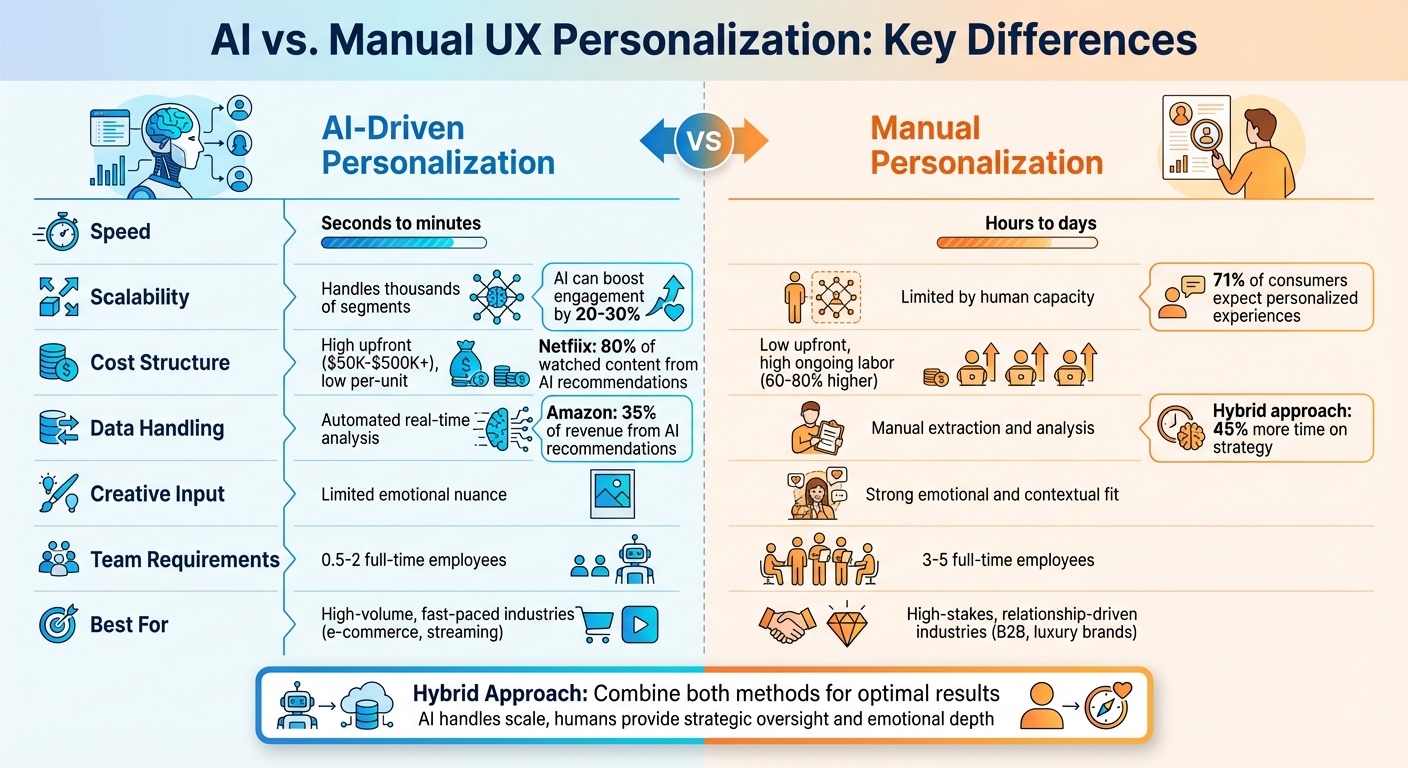
AI vs Manual UX Personalization: Key Differences Comparison Chart
How AI-Driven UX Personalization Works
AI-driven personalization works by tracking user behavior and updating interfaces in real time. It gathers a wide range of signals - like scroll depth, mouse movements, hesitation points, time spent on specific sections, and interactions with product attributes. It also considers contextual factors such as device type, location, time of day, and recent search history to tailor what users see. This continuous data collection feeds the machine learning models that create these personalized experiences.
Machine Learning's Role in Personalization
Machine learning transforms behavioral data into personalized UI adjustments using three main techniques:
- Supervised learning uses labeled historical data to categorize users.
- Unsupervised learning detects hidden patterns without predefined categories.
- Reinforcement learning treats UI personalization as a sequence of decisions, where systems like Deep Q-Networks reorder content to maximize engagement.
For instance, LSTM networks analyze past interactions to predict a user’s next move. If someone frequently reads product reviews before purchasing, the AI prioritizes review content earlier in their browsing experience. Studies show that AI-driven layouts and content ranking can boost engagement metrics by 20% to 30% compared to rule-based methods. In one experiment, dashboards powered by AI increased click-through rates from 0.21 to 0.29 (a 38% jump) and improved task success rates from 0.68 to 0.87.
Recommendation engines play a big role here, using methods like collaborative filtering (finding similarities in user behavior), content-based filtering (analyzing item attributes), or a hybrid of the two. These systems don’t just respond to user actions - they anticipate needs, often before users are even aware of them. Behind the scenes, a sophisticated tech stack automates these processes, as explained below.
Common Tools and Technologies
The personalization stack of 2026 integrates several cutting-edge technologies. Customer Data Platforms like Segment and RudderStack track behavioral events, while vector databases such as Pinecone and Weaviate store semantic data (embeddings) to process user intent in real time.
Personalization engines like Dynamic Yield (priced over $50,000/year) and Optimizely (starting at $36,000/year) handle automated content delivery using machine learning. Tools like Mixpanel, Hotjar, and Fullstory provide the behavioral insights that AI models need to spot patterns and friction points.
Search platforms like Algolia (starting at $29/month) use Natural Language Processing to deliver fast, typo-tolerant search results that adjust to user behavior. Emerging generative UI technologies, such as Vercel v0 and React Server Components, allow AI to dynamically create interface structures. Adobe Firefly Services even customizes visual elements like banners in real time based on user context.
How Manual UX Personalization Works
Manual UX personalization relies on predefined if/else rules and follows a structured approach known as the seven-level Personalization Pyramid Framework. This framework includes defining a North Star strategy, setting KPIs, identifying touchpoints, planning campaigns, segmenting users, activating data, and collecting raw data. By using this methodical process, businesses ensure their personalization efforts are aligned with strategic goals.
This approach leverages role-based segmentation, using known user data like job function, location, or purchase history. Designers create "targeted zones" in wireframes where specific rules dictate content changes. Onboarding quizzes often encourage users to self-identify, which triggers tailored experiences like customized workspaces. The results can be impressive: personalized calls-to-action outperform generic ones by as much as 202%, and 80% of businesses use first-party data to fuel these efforts.
Unlike AI-driven automation, manual personalization thrives on deliberate, creative decision-making to craft user experiences.
Human Creativity in UX Design
Designers bring an irreplaceable human touch to UX personalization, offering emotional depth and a nuanced understanding of psychology that automated systems struggle to replicate. Through manual wireframing, they ask critical questions about user goals and challenges - areas where AI often falls short.
"AI lacks the necessary understanding of human psychology required to solve a user's problems."
- Neil Nkoyock, UX Designer
Designers also ensure that personalization aligns with long-term brand goals, using their market knowledge and strategic judgment. They excel at interpreting non-verbal cues during user research, capturing subtleties that AI might miss. While 90% of UX professionals now integrate AI tools into their workflows, human creativity remains essential for projects requiring originality or cultural sensitivity.
Techniques and Tools in Manual Personalization
To refine user experiences, designers rely on a mix of techniques and specialized tools.
- Progressive disclosure: This technique hides advanced features until the user needs them, keeping interfaces clean and intuitive.
- User-controlled customization: Offering toggles for themes, notifications, and widgets allows users to tailor their experience.
- Modular layouts: Designers use these to create wireframes with distinct zones, which can be rearranged based on user segments.
A variety of tools supports these efforts. UI design platforms like Figma, Sketch, and Adobe XD help create layouts and reusable components. Prototyping tools such as Axure RP and Framer enable designers to build interactive mockups with conditional logic to test user flows. For gathering user preferences, tools like SurveyMonkey and Google Forms are invaluable, while platforms like Hotjar and Dovetail reveal friction points through UX analysis. Content Management Systems, including Sitecore and Adobe, deliver the personalized content based on predefined rules.
"Customization is user-controlled tailoring. The user explicitly chooses settings, layout, options... The user is the driver."
- Yevhen Synii, UI/UX Designer
Designers adhere to key principles to ensure effective personalization. They avoid overwhelming users by introducing high-impact toggles first and gradually revealing more options. Maintaining a consistent interface skeleton while personalizing content helps users feel grounded. Smart defaults simplify decision-making, and providing a reset or opt-out option builds trust.
AI-Driven vs. Manual UX Personalization: Direct Comparison
Comparison Table: Key Factors
When comparing AI-driven and manual UX personalization, the differences become striking, especially in areas like speed, cost, scalability, and creative control. AI can churn out personalized content in mere seconds or minutes, whereas manual methods often take hours or even days to complete a single campaign. This efficiency makes AI a game-changer for operational workflows.
Cost is another area where the two approaches diverge significantly. AI-driven personalization involves a steep upfront investment - ranging from $50,000 to over $500,000 for enterprise-level setups. However, once implemented, the per-unit cost drops dramatically as the system scales. On the other hand, manual methods may start with relatively low technology expenses but lead to 60–80% higher labor costs over time. For instance, Lenovo's switch from manual, agency-led processes to AI-driven automation in 2024 saved the company $16 million in just one year.
| Factor | AI-Driven Personalization | Manual Personalization |
|---|---|---|
| Speed | Seconds to minutes for content creation | Hours to days per campaign |
| Scalability | Can handle thousands of segments at once | Limited by the capacity of human teams |
| Cost Structure | High initial cost; low per-unit cost | Low entry cost; high ongoing labor costs |
| Data Handling | Automated real-time analysis of large datasets | Manual extraction using spreadsheets and reports |
| Creative Control | Delivers variations but may lack emotional nuance | Strong emotional and contextual resonance |
| Team Requirements | Requires 0.5–2 full-time employees | Requires 3–5 full-time employees |
This table highlights the core trade-offs between speed and the depth of human involvement.
Main Trade-Offs Between AI and Manual Methods
The key tension lies between the speed and scalability of AI and the nuanced judgment that human designers bring to the table. AI systems can adapt user interfaces in milliseconds by analyzing real-time behavioral cues like mouse movements and dwell time. For example, Lucid AI improved execution times by 40% and boosted performance by 25% by automating previously manual processes.
Yet, AI isn't without limits. While it excels in efficiency, it often struggles with the emotional depth and contextual sensitivity that humans naturally provide. Kevin from Fieldgrade puts it succinctly:
"The AI handles what it should, and my team handles what we do best. No confusion about roles, no redundant work. Just better marketing, faster."
Manual methods, meanwhile, shine in high-stakes scenarios where precision and oversight are critical.
Some teams are finding success by blending the two approaches. Agencies like Ghost Note use AI to shorten campaign launch times from weeks to days while keeping creative oversight intact. AI tools have also freed up significant time for strategic work - teams using AI now spend 45% of their time on planning, compared to 30% for those relying solely on manual methods. This hybrid approach allows teams to combine the efficiency of AI with the creative expertise of human designers.
These trade-offs illustrate why many organizations are adopting a middle ground, leveraging AI for speed and scalability while relying on human insight for creativity and precision.
Strengths and Weaknesses of Each Method
Strengths of AI-Driven Personalization
AI-driven personalization is incredibly efficient, handling millions of segments without requiring manual input. Its predictive algorithms can interpret micro-signals like scroll depth and dwell time to predict user preferences and behavior. This allows businesses to tailor experiences with precision.
The efficiency gains are impressive. For instance, Spotify used AI to analyze engagement data, factoring in genre, tempo, and mood preferences. This approach significantly boosted both its user base and revenue. Companies adopting AI-driven personalization often see major benefits, such as cutting technical workloads by 2–5× and increasing revenue by about 40% in fast-growing organizations. AI's ability to adapt dynamically provides a level of hyper-targeted personalization that manual methods simply can't achieve.
But these advantages don't come without challenges.
Weaknesses of AI-Driven Personalization
One major drawback of AI-driven personalization is the high upfront investment required, which can be a hurdle for many businesses. Additionally, AI often struggles to capture emotional nuances. While it can churn out variations quickly, it may lack the subtlety needed to maintain a consistent brand voice.
Data bias is another issue. AI models trained on historical data can unintentionally reinforce stereotypes or exclude certain groups. This concern is significant, with 63% of Americans expressing unease about algorithmic decision-making.
Another limitation is the "black box" nature of many AI systems, where the reasoning behind decisions isn't always clear. Continual retraining is necessary to prevent model drift, and without proper oversight, AI outputs can veer away from the desired tone or messaging.
In contrast, manual personalization offers a more human-centered approach to address these gaps.
Strengths of Manual Personalization
Manual personalization shines in its ability to create emotional connections. Human designers can interpret subtle cultural cues and align experiences closely with brand values. This approach also ensures full transparency, as teams can clearly explain the reasoning behind their decisions, fostering trust with stakeholders.
Weaknesses of Manual Personalization
The biggest challenge with manual personalization is scalability. Rules-based systems require setting up every possible customer journey, which becomes overwhelming as the number of segments grows. Francesco Montesanto, Content Marketing Manager at Optimizely, sums it up well:
"Rules-based personalization requires a lot of leg work and refinement. You need to have eyes on all segments at all times, while constantly validating data and information."
Manual methods are also time-consuming. Tasks like data extraction, segmentation, and crafting personalized content can take hours or even days, unlike AI's near-instant results. This delay can make it difficult to respond quickly to changing market conditions. There's also a risk of inconsistency, as manually managed personalization might lead to conflicting messages or promotions across different channels. Frequent reviews are essential to keep content relevant as user preferences evolve. While initial technology costs may be lower, the ongoing labor expenses can add up over time.
Though manual methods provide emotional depth and transparency, their slower pace and higher workload make them less effective in fast-paced environments.
Best Use Cases for Each Method
When to Use AI-Driven Personalization
Choosing the right personalization method depends heavily on context, and AI-driven personalization shines in high-volume, data-intensive environments where speed and scalability are key. For instance, e-commerce platforms see massive benefits - Netflix attributes 80% of its watched content to AI-driven recommendations, while Amazon credits 35% of its revenue to similar systems. These algorithms process millions of user interactions in real-time, something no human team could match.
Streaming services, B2B SaaS platforms, and EdTech applications are prime examples of where AI thrives. From onboarding flows and adaptive learning paths to lead processing, AI adjusts experiences dynamically as users interact. Food delivery apps also leverage AI for real-time reordering suggestions based on user behavior and time of day. The growing demand for such technology is evident, with the market expected to hit $11.6 billion by 2026.
Real-world examples highlight AI’s impact: Lenovo and Lucid AI have both reduced costs and improved efficiency by automating tasks that were previously manual. AI’s ability to manage thousands of audience segments simultaneously while keeping costs low makes it indispensable for organizations operating at scale. This contrasts sharply with scenarios requiring the nuanced decision-making that only humans can provide.
When to Use Manual Personalization
While AI handles scale effortlessly, manual personalization is crucial in high-stakes, relationship-focused situations where human judgment and trust-building are irreplaceable. For instance, securing six-figure B2B contracts with Fortune 500 companies often demands the nuanced interactions and emotional intelligence that only humans can deliver. Similarly, boutique luxury brands rely on manual personalization to ensure every customer touchpoint reflects their brand values and evokes the desired emotional connection.
Regulated industries like finance and healthcare also depend on manual oversight to ensure compliance and accuracy. Handling sensitive data or meeting strict quality standards often requires human involvement to avoid costly mistakes. Moreover, 68% of users report higher trust in platforms that allow manual overrides of automated features, underscoring the importance of user control in critical applications.
Manual approaches are also better suited for niche audiences that require highly tailored communication or exploratory interfaces where user autonomy is key. When projects involve complex cultural dynamics or demand a consistent brand voice across limited interactions, the human touch remains the superior choice.
Combining AI and Manual UX Personalization
How to Combine AI and Manual Methods
AI shines in handling large-scale, data-heavy tasks, while manual methods bring a human touch to strategy and emotional nuance. A hybrid approach blends these strengths, allowing AI to tackle tasks like analyzing user behavior, segmenting audiences, and generating content variations at scale. Meanwhile, human designers focus on areas requiring empathy, cultural understanding, and brand voice - elements that machines can't replicate.
Case studies highlight the effectiveness of hybrid workflows. For instance, Lucid AI streamlined operations in 2025 by replacing five manual tools with a single hybrid platform, resulting in faster execution and improved performance. The success of such systems lies in clearly defined roles: AI serves as a copilot, while humans retain control over critical decisions.
Start with brainstorming sessions free of AI to encourage pure creativity, then use AI to build on those ideas. Keep an AI usage log to document where and how AI is applied. This helps teams validate outputs and spot errors. For decisions impacting brand credibility, human oversight remains essential.
"The AI handles what it should, and my team handles what we do best. No confusion about roles, no redundant work. Just better marketing, faster." - Kevin, Marketing Lead at Fieldgrade
This clear division of responsibilities not only streamlines workflows but also sets the foundation for measurable improvements.
Benefits of a Hybrid Approach
Hybrid methods offer clear operational and financial gains by combining the scalability of AI with human precision. Automating repetitive tasks - like data analysis and pattern recognition - can free UX teams to focus on strategy. For example, hybrid models allow teams to spend 45% more time on strategic planning, as AI tools reduce research time by 60–70%.
The financial benefits are equally compelling. Marketing teams save around 2 hours for every hour spent using hybrid AI platforms, with savings increasing to 3–5× for more technical tasks. Agencies like Ghost Note leveraged these efficiencies in 2025, launching complex personalized campaigns in just days instead of weeks. Additionally, hybrid personalization has been shown to increase average revenue per user by 166%.
Another key advantage is error detection. While full automation excels at spotting high-severity usability issues, hybrid approaches are better at identifying subtle, low-severity problems that require human judgment. Combined with human oversight to ensure outputs align with brand identity, hybrid workflows deliver scalable yet emotionally engaging user experiences.
Conclusion
AI-driven and manual UX personalization each bring unique advantages to the table. AI shines when speed, scale, and data processing are critical - making it a go-to solution for high-volume environments like e-commerce. On the other hand, manual personalization offers emotional depth, cultural awareness, and strategic control, which are invaluable in high-stakes scenarios like B2B interactions.
Here’s the reality: 71% of consumers expect personalized experiences, and companies leveraging AI for personalization have reported conversion rate boosts of 10–30%. However, relying solely on AI can lead to personalization that feels invasive, while manual approaches - though emotionally intuitive - often fall short when it comes to scalability.
The solution? A hybrid approach. Let AI handle the heavy lifting - tasks like data analysis, audience segmentation, and initial content creation - while human expertise ensures strategic alignment, creative direction, and brand consistency. Teams adopting this model spend 45% more time on strategy and execute campaigns 40% faster compared to traditional methods.
This balanced approach enables smarter, more informed design decisions. Use AI to optimize at scale and cut research time by 60–70%. Lean on manual methods when your focus is on maintaining a specific brand voice, handling sensitive cultural nuances, or building complex relationships. Today’s UX challenges demand both high-quality data and thoughtful strategy.
FAQs
How do I choose AI vs. manual personalization for my product?
Choosing between AI and manual personalization comes down to your product’s specific needs and objectives. AI shines when it comes to speed, scalability, and managing large volumes, making it perfect for real-time, dynamic experiences. On the other hand, manual personalization brings a level of depth and emotional connection that works well for niche audiences or high-value customer groups. Often, the best solution is a mix of both - leveraging AI’s efficiency alongside human creativity and thoughtful strategy.
What data do I need to start AI-driven UX personalization?
To kick off AI-driven UX personalization, start by gathering first-party data through consent-based methods. This includes tracking user interactions, behaviors, and contextual signals such as the content they view and the devices they use. Tools like a Customer Data Platform (CDP) can help you organize, segment, and analyze this data effectively. Additionally, incorporating real-time behavioral data is key for making dynamic adjustments to the user experience. By focusing on first-party, behavioral, and contextual data, you can build personalized experiences that resonate with users on a larger scale.
How can I safely combine AI and human UX decisions?
To effectively blend AI with human-driven UX decisions, adopt a hybrid approach. Assign AI tasks that are data-intensive, such as personalization and automation, while leaving areas like emotional and strategic design to human expertise. Keep human oversight active at critical decision-making stages, regularly review AI outputs to catch potential biases, and encourage open collaboration between AI systems and UX professionals. This approach combines the efficiency of AI with the empathy and insight of humans, ensuring user needs remain a priority alongside broader strategic objectives.