
How Cart Recovery Tools Improve Checkout UX
Cart recovery tools fix checkout friction by simplifying checkout, using AI exit-intent popups and multi-channel reminders to reclaim abandoned carts.

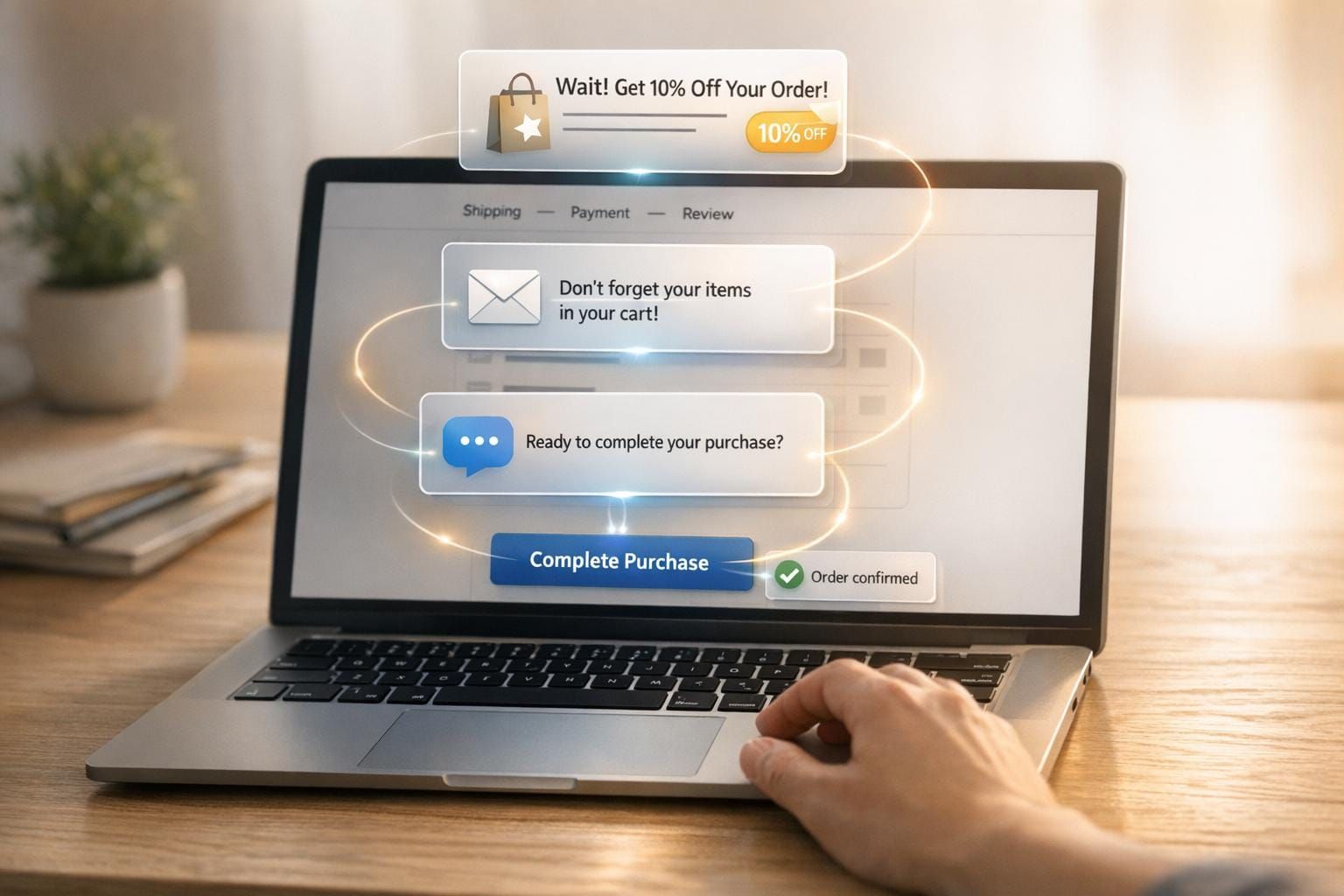
Did you know? Nearly 70% of online shopping carts are abandoned, costing businesses over $260 billion annually in lost sales. High abandonment rates are often caused by unexpected costs, forced account creation, and long checkout processes.
The solution? Cart recovery tools. These tools help businesses reclaim 15–30% of lost sales by simplifying checkout, offering multi-channel reminders (email, SMS, push notifications), and using AI to predict abandonment.
Key takeaways:
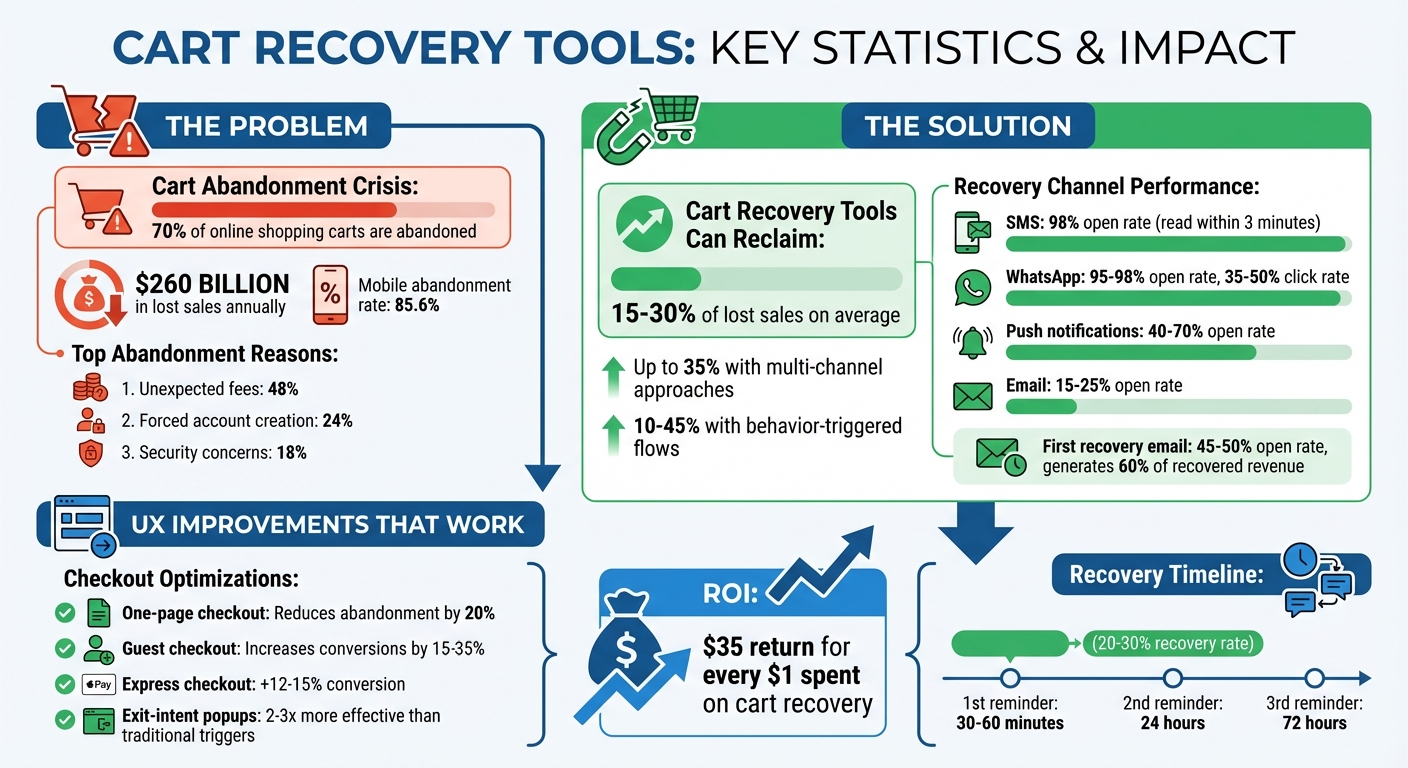
- Top reasons for cart abandonment: Unexpected fees (48%), forced account creation (24%), and security concerns (18%).
- Mobile struggles: Cart abandonment rates on mobile hit 85.6% due to small touch targets and lengthy forms.
- Recovery strategies: Tools like Klaviyo and Omnisend send personalized reminders, offer guest checkout, and simplify forms for better UX.
- Proven results: One-page checkouts reduce abandonment by 20%, while SMS reminders boast a 98% open rate.
Cart Abandonment Statistics and Recovery Strategies
How Cart Recovery Tools Improve Checkout UX
Cart recovery tools transform the checkout process by tackling common obstacles and re-engaging shoppers who abandon their carts. The result? A smoother journey from "add to cart" to "order complete."
Simplified Checkout Features
One of the biggest reasons shoppers abandon their carts is a complicated checkout process. Cart recovery tools solve this by introducing one-page checkouts, which streamline the process and reduce uncertainty about how long it will take. This approach can cut abandonment rates by around 20%, addressing what Digital Applied refers to as "progress anxiety" - the concern that checkout might take longer than expected.
Another game-changer is the guest checkout option, which removes the hassle of mandatory account creation. This small adjustment makes it easier for shoppers to complete their purchases without unnecessary steps.
On the tech side, these tools integrate features like address auto-complete using the Google Places API, speeding up the process and improving accuracy. For mobile users, numeric keypads are triggered for credit card and CVV fields, and express checkout buttons like Apple Pay and Google Pay are highlighted. These features make it possible to complete a purchase in just two taps, increasing conversion rates by 12–15%. Together, these improvements create a smoother checkout experience while setting the stage for re-engagement strategies.
Exit-Intent Popups and Progress Indicators
Even with a simplified process, some shoppers hesitate. This is where exit-intent popups and progress indicators come into play. Using AI, exit-intent tools predict when a shopper is about to leave - often within 2 to 4 seconds - and trigger a personalized popup. These popups might offer free shipping, a "save for later" option, or a reminder of items in the cart. They’re 2–3 times more effective than traditional rule-based triggers.
Progress indicators, like a "Step 2 of 3: Shipping Information" bar, also help. By showing how far along a shopper is in the process, they tap into what’s called endowed progress, motivating people to complete a task. As the Fullstory Team explains:
"People are more likely to complete a task if they are alerted of the progress (real or artificial) towards this task".
This visual cue reduces uncertainty and keeps shoppers moving forward.
Multi-Channel Recovery Reminders
If a shopper leaves before completing their purchase, cart recovery tools spring into action with reminders sent across multiple channels, including email, SMS, and push notifications. The first reminder typically goes out within 30 to 60 minutes of abandonment, while intent is still high. Additional messages follow at 24 and 72 hours, often featuring product images, names, and a direct link to the pre-filled cart.
Among these channels, SMS stands out with a 98% open rate, and most messages are read within 3 minutes. Similarly, WhatsApp messages achieve open rates of 95–98% and click rates between 35–50%. Push notifications see open rates between 40–70%, while email reminders typically range from 15–25%.
A standout feature of these strategies is stop-on-recovery logic. Once a purchase is completed, all scheduled reminders are canceled to avoid annoying the customer. Other thoughtful touches include contact reconciliation to avoid duplicate messages and quiet hours (usually 9 PM to 9 AM) to ensure notifications arrive at appropriate times. Stores using these multi-channel approaches can recover over 35% of abandoned carts, far outperforming the 5–10% recovery rate of email-only campaigns. This approach not only recovers lost sales but also creates a more considerate and customer-focused experience.
Top Cart Recovery Tools for UX Optimization
Choosing the right cart recovery tool is key to creating a smoother checkout process. The most effective platforms combine multiple communication channels - like email, SMS, and push notifications - with AI-driven features that offer quick, predictive insights. Many modern tools even provide checkout-ready links, allowing customers to skip the cart and go straight to a pre-filled payment page.
When comparing tools, look for those that support persistent carts across devices. This ensures shoppers can switch between mobile and desktop without losing their progress. Additionally, tools that integrate seamlessly with payment gateways such as Stripe, PayPal, and Shop Pay provide a more streamlined experience. Some advanced platforms take it a step further with AI-powered margin-aware incentives. These systems calculate the smallest discount needed to convert a sale, based on product margins and customer sensitivity to pricing. This approach avoids conditioning customers to expect discounts while still improving conversion rates. Together, these features enhance the transition from cart to checkout, building on earlier UX improvements to create a seamless buying journey.
Here’s a breakdown of some top tools to consider.
Cart Recovery Tools Comparison
| Tool | Primary Channels | Key UX Features | Payment Integrations | Starting Price |
|---|---|---|---|---|
| Klaviyo | Email, SMS | AI-driven product recommendations, dynamic content | Stripe, PayPal, Shop Pay | $45/month |
| Omnisend | Email, SMS, Push | Multichannel workflows, BNPL support | Stripe, PayPal, Shop Pay | $16/month |
| CartStack | Email, SMS, Push | Checkout-ready links, persistent carts | Stripe, PayPal, Square, Authorize.net | $29–$39/month |
| ActiveCampaign | Email, SMS, CRM | Advanced behavioral segmentation | Stripe, PayPal (via Zapier) | $29/month |
| Justuno | On-site Popups | AI exit-intent, A/B testing | Integrates with major ESPs | $35/month |
A Shopify direct-to-consumer (DTC) merchant shared:
"We reclaimed 17% of abandoned carts with Klaviyo's Stripe-enabled automations".
This example shows how the right tool, combined with proper integration, can dramatically improve cart recovery rates while enhancing the checkout experience.
How to Integrate Cart Recovery Tools into Your Checkout
Once you've chosen a cart recovery tool, the next step is integrating it into your checkout process. This typically involves installing a plugin (like FunnelKit or WooCommerce Abandoned Cart Recovery) or connecting a customer engagement platform such as Klaviyo or Braze. Make sure to enable cart tracking so you can instantly identify abandoned carts and take action. Here's how to make the integration work effectively.
Collect User Data During Checkout
Recovery tools need customer contact information to do their job. To ensure you can reach users, adjust your checkout process to capture email addresses or phone numbers as early as possible. This could mean placing the contact field at the very top of your checkout form or capturing details in real time as users type them. You can also use exit-intent popups to grab contact information before users leave your site. This step is essential because it enables your recovery system to engage customers even if they abandon the checkout halfway through.
Configure Automated Recovery Sequences
With your checkout streamlined and contact data secured, it's time to set up automated recovery sequences. Start by defining when a cart is considered "abandoned" - usually after 30 to 60 minutes of inactivity. Then, create a multi-channel recovery flow (email, SMS, push notifications) following a three-step timeline:
- One hour: Send a friendly reminder about the abandoned cart.
- 24 hours: Add social proof or reassurance to encourage trust.
- 72 hours: Offer a final incentive, like free shipping or a small discount.
Use merge tags to personalize messages with product details and include a one-click recovery link. For more advanced setups, integrate with payment processors like Stripe and configure webhook listeners to detect expired checkout sessions and automatically trigger recovery URLs.
Monitor Recovery Performance
Once your recovery sequences are live, keep an eye on their performance to fine-tune your approach. For example, recovery emails sent within the first hour often achieve a 20–30% recovery rate, while SMS messages have an impressive 98% open rate, far surpassing email's average of 20%. Implement suppression logic to immediately remove customers from the recovery flow as soon as they complete a purchase - this avoids redundant messaging and helps maintain your brand's reputation. Regularly test and adjust elements like timing, subject lines, and incentives to optimize your recovery rates.
Measuring UX Improvements and Best Practices
Monitor Key Performance Metrics
Keeping an eye on the right metrics can show you if your cart recovery tools are actually improving the checkout process. The incremental revenue metric is especially crucial - it reflects sales that only happen because of your recovery messages. Typically, this figure falls between 8–15% of abandoned carts. It’s important to focus on this number instead of total recovered revenue, which can give a misleading picture of ROI.
"Measure incremental revenue - sales that would not have happened without intervention - not total recovered revenue, which inflates ROI calculations." – Digital Applied
To measure accurately, set up a 10–20% holdout group that doesn’t receive recovery messages. This gives you a baseline to see how many customers naturally return without any intervention. For example, in 2025, BlaBlaCar used behavior-triggered recovery flows via Braze, resulting in a 30% boost in bookings and a 48% increase in click rates by sending automated messages with pre-filled booking details. Similarly, Uber Carshare saw a 20% lift in conversions by using segmented, in-app recovery flows.
Another key metric is the discount attachment rate, which measures how often coupons are used in recoveries. Aim to keep this below 30% to avoid training customers to expect discounts. Also, monitor the unsubscribe rate for recovery messages - it should stay under 0.5%. A higher rate might mean you’re sending too many messages or targeting the wrong audience.
Use A/B Testing to Optimize Results
Once you’ve got a handle on your metrics, use A/B testing to fine-tune your approach. Testing different strategies can help you figure out what resonates best with your audience. For example, compare sending the first recovery email 30 minutes after abandonment versus one hour later. Interestingly, the first email often generates about 60% of recovered revenue and typically achieves open rates between 45–50%. You can also test whether a three-email sequence outperforms a four-email sequence, or experiment with subject lines and incentive levels.
Refining the checkout process can also make a big difference. For instance, making guest checkout the default option can increase conversions by 15–35%. ASOS saw a 50% drop in checkout abandonment after switching to a streamlined, one-page checkout flow. Another idea is to test showing specific delivery dates like "Arrives by Friday" versus vague shipping estimates like "3–5 business days" - this can help reduce decision-making stress.
Use the PIE framework to rank your testing ideas based on potential, impact, and ease. Don’t forget to analyze mobile and desktop results separately, since mobile users often face unique challenges like thumb reach issues or slower page loads. Once your strategies are proven effective, make sure they align with data privacy rules.
Maintain Compliance with Data Regulations
While improving your recovery efforts, it’s essential to handle customer data responsibly. Cart recovery tools collect sensitive information, so staying compliant with regulations like GDPR and TCPA is non-negotiable. Under GDPR, abandoned cart emails are usually considered "transactional" and fall under legitimate interest. However, SMS and WhatsApp reminders require explicit prior consent, often through an unchecked box at checkout.
Your privacy policy should clearly outline what data you collect (e.g., email, phone numbers, cookies), why you collect it, and how long you keep it. Every recovery message must include an easy way to opt out, such as an unsubscribe link or a "STOP" instruction. For SMS, stick to quiet hours - typically between 9:00 PM and 8:00 AM - to avoid breaking the rules.
Non-compliance can be costly. GDPR violations can lead to fines of up to $21 million or 4% of annual global revenue. TCPA violations, meanwhile, can cost $500–$1,500 for each unsolicited text message. To stay safe, only keep customer data as long as it’s needed for recovery purposes, then delete or anonymize it. Also, audit any third-party tools you use for cart recovery to ensure they meet compliance standards, as you’re ultimately responsible for how they handle data. Following these legal guidelines not only protects your business but also builds trust with your customers, which is a cornerstone of good UX.
Conclusion
Cart recovery tools are more than just email reminders - they tackle the root causes of checkout friction while boosting revenue and improving the user experience. With eCommerce cart abandonment rates averaging 70%, the potential to recover lost sales and enhance customer satisfaction is immense. As Digital Applied aptly puts it:
"Cart abandonment is not a bug - it is a feature of how people shop online".
The key to success lies in blending smart automation with thoughtful design. Features like exit-intent popups, progress indicators, and multi-channel recovery strategies (email, SMS, push notifications) can recover anywhere from 10% to 45% of abandoned carts. Addressing checkout pain points - like enabling guest checkout, simplifying forms, and adding trust signals - further amplifies results. Research shows that behavior-triggered recovery flows with pre-filled details can increase bookings by 30% and click rates by 48%.
To maximize effectiveness, implement a three-email recovery sequence, enable guest checkout, and use inline form validation. A/B testing different strategies and tracking incremental revenue (not just total recovered sales) will help you identify what works best. With an average return of $35.00 for every $1.00 spent, cart abandonment recovery is one of the most profitable marketing investments you can make.
Tailor your approach to specific customer challenges. If 48% of shoppers leave due to unexpected costs, focus on transparent pricing and clear shipping thresholds. For mobile users - where abandonment rates can hit 85.6% - offer express checkout options like Apple Pay and Google Pay. Choose tools that integrate seamlessly with your platform, enabling personalized follow-ups without adding unnecessary workload.
Finally, keep refining your strategy. Monitor performance metrics, experiment with new approaches, and stay compliant with data privacy regulations. By doing so, you’ll create a checkout process that not only converts more visitors into buyers but also builds long-term trust and loyalty.
FAQs
What’s the best time to send the first cart recovery message?
The best window to send the first cart recovery message is within 1 to 4 hours after the cart is abandoned. This approach works because it taps into the moment when the customer's intent to buy is still fresh, increasing the chances they'll return to complete their purchase.
How do I measure incremental revenue from cart recovery?
To figure out incremental revenue, you need to track sales that only happened because of your recovery efforts. One way to do this is by using unique discount codes to attribute sales directly to your campaigns. Another approach is analyzing behavioral data to pinpoint carts that were recovered due to your actions. Focus on purchases completed specifically after your recovery strategies were implemented, and calculate the revenue tied directly to these interventions. This way, you're measuring the actual extra revenue generated - not just recovered sales - giving you a better picture of your strategy's impact.
What consent do I need for SMS cart recovery in the US?
In the U.S., businesses are required to secure express written consent before sending SMS cart recovery messages. This consent must be clear, easy to identify, and thoroughly documented. Simply relying on verbal consent won’t meet the legal requirements.