
CDN Impact on Mobile UX in E-commerce
How CDNs speed mobile e-commerce: cut latency, improve Core Web Vitals, boost conversions and reduce bounce rates.


Mobile e-commerce thrives on speed. If your site takes more than 3 seconds to load, 53% of users will leave. With mobile devices driving 73% of e-commerce traffic but contributing only 58% of revenue, slow load times are costing businesses billions. CDNs (Content Delivery Networks) are the solution, reducing latency by caching content closer to users and optimizing delivery.
Key Takeaways:
- Faster Load Times: CDNs cut latency by up to 50%, improving metrics like Time to First Byte (TTFB) and Largest Contentful Paint (LCP).
- Boosted Conversions: A 0.1-second speed improvement can increase mobile conversion rates by 8.4%.
- Advanced Features: Modern CDNs use HTTP/3, image optimization, and edge caching for better mobile performance.
- Revenue Impact: Delays of 100ms can reduce sales by 1%. Faster sites lead to higher engagement, lower bounce rates, and increased revenue.
By leveraging CDNs effectively, businesses can close the gap between mobile traffic and revenue, ensuring their sites load quickly and perform reliably for users worldwide.
Research on CDN Impact on Mobile Load Times
How CDNs Reduce Page Load Times
CDNs (Content Delivery Networks) play a key role in speeding up page load times by caching content on edge servers located closer to users. This reduces the distance data needs to travel, leading to significant improvements in both Round Trip Time (RTT) and Time to First Byte (TTFB). For instance, one study found that implementing a well-optimized CDN reduced the global median TTFB from 420 milliseconds to just 85 milliseconds - a dramatic 70% decrease.
Beyond caching, CDNs leverage advanced protocols like HTTP/2 and HTTP/3 (QUIC). These protocols enable multiplexing, which ensures that a slow-loading resource doesn’t delay others - a critical feature for the often-unpredictable nature of mobile networks. CDNs also handle TLS handshakes at the edge, employing methods like TLS 1.3 and 0-RTT resumption to cut down on connection overhead.
Another major advantage is automated image optimization. CDNs can resize, compress, and convert images into modern formats like WebP or AVIF in real time, reducing image file sizes by 30–50%. Additionally, moving logic such as redirects and geo-routing to edge servers eliminates unnecessary trips to the origin server, further speeding up load times. These optimizations have tangible results: documented e-commerce deployments have shown Largest Contentful Paint (LCP) times dropping from 4.2 seconds to 2.1 seconds - a 50% improvement.
These advancements not only improve load times but also enhance user satisfaction and retention. This connection is explored further in the next section.
Load Time Effects on Mobile User Retention
The impact of faster load times on mobile user retention is well-documented. Research highlights a clear relationship between slower load speeds and higher bounce rates. For example, when mobile page load time increases from 1 to 3 seconds, the probability of users bouncing jumps by 32%. At 5 seconds, bounce rates soar by over 90%.
Major companies have quantified the financial impact of latency. Amazon reports that every additional 100 milliseconds of delay can reduce revenue by about 1%. Similarly, Walmart Labs found that improving page load time by just 1 second boosted conversions by as much as 2%. A Deloitte Digital study, which analyzed billions of user sessions, revealed that shaving off just 0.1 seconds from mobile site speed led to an 8.4% increase in retail conversion rates and a 10.1% boost for travel sites.
"A 0.1 second improvement in mobile site speed correlated with increases in conversion rates, pages per session, and average order value across multiple verticals." – Deloitte
These findings underscore the importance of maintaining fast-loading mobile sites, especially in competitive industries like e-commerce. Sites that load in under 1 second consistently achieve the highest conversion and retention rates, while noticeable drop-offs occur when load times exceed 2–3 seconds.
sbb-itb-124fdbf
CDN Effects on Engagement and Conversion Rates
Faster Loading Increases User Engagement
Speed is everything when it comes to keeping users engaged, and CDNs play a huge role in making that happen. Faster-loading pages encourage users to stick around and interact more, especially on mobile devices. One global e-commerce platform revamped its delivery system and saw its mobile bounce rate drop from 42% to 33%. That 9-point improvement meant more shoppers stayed on the site longer, leading to higher engagement levels.
Mobile users are particularly sensitive to delays. Even small lags can cause them to abandon a page. CDNs help solve this by minimizing the distance between the content and the user, which reduces latency. This is especially important for mobile networks, where bandwidth and latency can be major hurdles.
But it’s not just about keeping users on the page. Faster load times encourage users to explore more - browsing additional products, spending more time on the site, and even adding items to their cart. By cutting down on waiting time, CDNs create a smoother, more enjoyable experience, setting the stage for better conversion rates.
Conversion Rate Improvements with CDNs
The connection between faster load times and higher revenue is clear. Take the example of a Shopify jewelry store that optimized images and implemented lazy loading using a CDN. In just 60 days, their average page load time dropped from 5.2 seconds to 1.8 seconds - a 65% improvement. The results? Mobile conversion rates jumped by 56% (from 1.4% to 2.18%), bounce rates fell by 38%, and monthly revenue soared from $96,000 to $138,000.
"In a world where a fraction of a second moves millions in revenue, a 50% reduction in page load time is not a cosmetic win - it is a business model upgrade."
– BlazingCDN
Research backs this up. A Google–Deloitte study found that shaving just 0.1 seconds off mobile site load times can increase retail conversions by up to 8.4%. For major e-commerce platforms, every 100 milliseconds of additional latency could cost around 1% of sales. One mid-sized online apparel retailer saw a 30% sales boost within three months of using a modern CDN to handle peak traffic periods. Similarly, a global retailer improved conversion rates by 6–10% by leveraging advanced CDN techniques like edge logic and image optimization.
CDN Performance Comparison in Mobile E-commerce
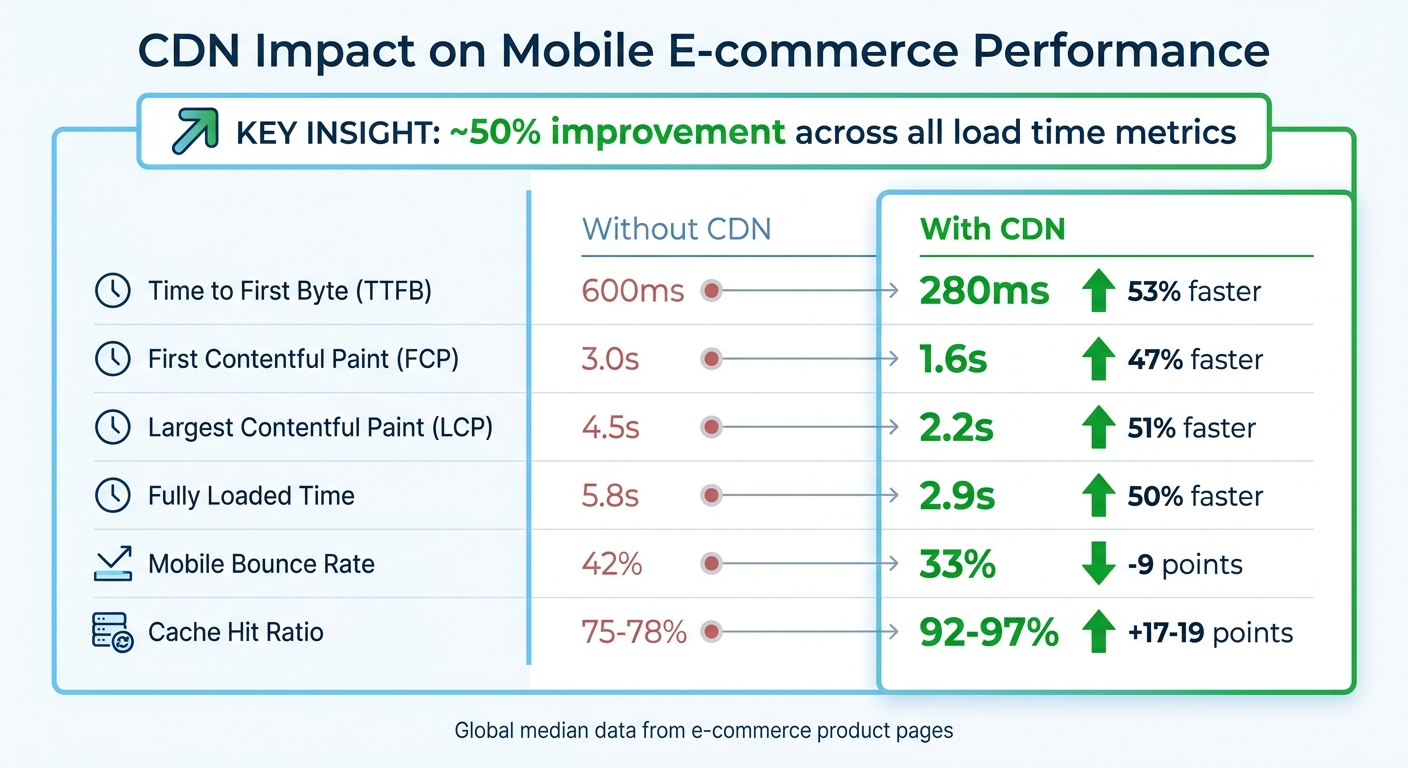
CDN vs Non-CDN Mobile E-commerce Performance Metrics Comparison
CDN vs. Non-CDN Mobile Performance Metrics
The performance gap between e-commerce platforms that use a CDN and those that don’t is striking. Without a CDN, platforms often face Time to First Byte (TTFB) issues, with delays exceeding 800–1,000ms during peak traffic. For mobile users on 3G/4G networks in emerging markets, this can mean 2–4 times slower page loads due to the distance between users and the data centers hosting the content.
CDNs tackle this problem by reducing the "hop count" - the number of network handoffs a request makes before reaching the user. They also use Anycast routing to connect directly to Tier 1 networks, streamlining data delivery. These optimizations have a direct impact on performance metrics. For instance, a CDN can improve Largest Contentful Paint (LCP) from a sluggish 3+ seconds to a much faster sub-2.5 seconds, which is crucial for mobile search rankings.
The table below highlights the performance improvements seen across global e-commerce retailers:
| Metric (Global Median, Product Page) | Without CDN Optimization | With CDN Optimization | Improvement |
|---|---|---|---|
| Time to First Byte (TTFB) | 600ms | 280ms | ~53% faster |
| First Contentful Paint (FCP) | 3.0s | 1.6s | ~47% faster |
| Largest Contentful Paint (LCP) | 4.5s | 2.2s | ~51% faster |
| Fully Loaded Time (Onload) | 5.8s | 2.9s | ~50% faster |
| Mobile Bounce Rate | 42% | 33% | -9 percentage points |
| Cache Hit Ratio | 75–78% | 92–97% | +17–19 percentage points |
These improvements are more than just numbers - they translate into real business benefits. Modern CDNs excel at managing HTTP-to-HTTPS redirects and geo-based routing, shaving off hundreds of milliseconds from request times that would otherwise be spent in roundtrips to the origin server. The jump in cache hit ratios - from 75–78% to 92–97% - ensures that most requests are served directly from the CDN, keeping performance consistent even during high-traffic events like Black Friday.
The business impact is undeniable. Enhanced performance metrics lead to better mobile user experiences and higher conversion rates. Data shows that systematic CDN optimization can increase global conversion rates by 20–30%. And with every 100 milliseconds of latency potentially costing a major retailer 1% in sales, the financial case for CDNs becomes crystal clear.
CDN Optimization Methods for Better Mobile UX
Mobile-First CDN Implementation Techniques
When it comes to improving mobile performance, several strategies stand out. For starters, switching to HTTP/3 (QUIC) can cut page load times on mobile devices by about 13% compared to HTTP/2. This is because HTTP/3 handles packet loss better and avoids head-of-line blocking, even when users transition between Wi-Fi and 5G during a session.
E-commerce sites, where product images often make up 60% to 80% of a page's total size, can benefit significantly from delivering images in next-gen formats like WebP and AVIF. Combining these formats with edge-side resizing can slash page weight by as much as 40–60%. For static assets like JavaScript and CSS files, using headers such as Cache-Control: public, max-age=31536000, immutable and incorporating content hashing into filenames ensures maximum cache efficiency and avoids unnecessary re-validation.
Mobile apps, which generate a high volume of small requests, can see faster performance by offloading TCP/TLS termination and using connection pooling at the edge. These methods reduce handshake overhead and improve efficiency. Additional tasks, like A/B testing, geo-redirects, and device-specific content delivery, can also be shifted to the edge to minimize round trips to the origin server.
For text-based assets, Brotli compression is a game-changer, reducing payload sizes by 15–20% more than Gzip. This is particularly helpful for users on slower or constrained mobile networks. To further optimize caching, strip unnecessary tracking parameters (e.g., utm_* and gclid) at the edge, preventing cache fragmentation and improving hit ratios. Finally, using resource hints like rel="preload" and rel="dns-prefetch" can speed up initial render times.
These strategies not only enhance performance but also align with earlier research that links faster load times to higher engagement and conversions. However, implementing these optimizations is just the first step - testing and validating their impact is equally critical.
Testing CDN Performance with Tools
Testing is essential to measure the effectiveness of your optimizations. A thorough evaluation combines synthetic testing and Real User Monitoring (RUM). Synthetic tests provide controlled benchmarks from specific regions, offering repeatable performance baselines. Tools like WebPageTest and Catchpoint are excellent for this purpose. On the other hand, RUM captures real-world data from actual users, including metrics like Largest Contentful Paint (LCP), Interaction to Next Paint (INP), and Cumulative Layout Shift (CLS), directly from mobile devices.
When testing, simulate different network conditions - such as 3G, 4G, and limited 5G speeds - to get a clearer picture of performance under various scenarios. Instead of focusing solely on averages, examine the p95 and p99 latency distributions for a more accurate understanding of user experience. Key targets include a Time to First Byte (TTFB) under 500 ms globally, an LCP under 2.5 seconds, and a cache hit ratio above 90% for static assets.
Your CDN's analytics dashboard can provide valuable insights into these metrics, helping you identify areas where semi-static content caching could be improved.
Limitations and Gaps in CDN-Mobile UX Research
While CDNs have proven their value in improving mobile e-commerce performance, there are still major gaps in research that limit our understanding of their true impact. One prominent issue is regional averaging. Studies often present broad benchmarks like "APAC" or "Latin America", which mask critical local differences. For instance, regional data might show averages, but they fail to highlight extremes. In Dubai, latency can be as low as 32 ms, while in Lagos it can climb as high as 146 ms. Similarly, in Auckland, latencies often exceed 120 ms due to limited terrestrial fiber exits. These disparities underline the importance of localized strategies for CDN deployment.
Another challenge stems from physical infrastructure gaps. Sub-Saharan Africa, for example, relies heavily on satellite links, while outdated networks remain a problem in parts of the Middle East and Africa. These issues worsen performance disparities that CDNs alone cannot fix. Additionally, natural disasters in regions like APAC - such as typhoons or earthquakes - can damage subsea cables, forcing traffic rerouting and adding over 90 ms of latency.
Beyond these technical hurdles, organizational practices also limit the effectiveness of CDNs. Many businesses approach CDN implementation with a "checkbox mentality", treating it as a one-time setup rather than an ongoing optimization process. According to BlazingCDN:
"Simply 'turning on a CDN' is not enough. To really attack latency, you need to configure and use it intelligently."
This oversight often negates the potential benefits of CDNs. Research shows that 53% of mobile users abandon a page if it takes longer than three seconds to load. CDNs alone cannot solve this; additional optimizations like image compression, code minification, and script management are essential.
Performance testing limitations further complicate the picture. Many studies fail to separate network latency from application-layer bottlenecks, leading to misdiagnoses. For example, slow SQL queries or backend processing delays are often mistaken for network issues. Moreover, there is limited research on how CDNs impact modern Single Page Applications (SPAs) built with frameworks like React or Vue. In these cases, JavaScript execution often becomes the primary bottleneck, overshadowing the role of asset delivery. Compliance requirements, such as GDPR, add another layer of latency when traffic must be routed through specific regions for inspection, yet these delays are rarely accounted for in standard performance studies.
These gaps highlight that while CDNs undeniably enhance mobile UX, our understanding of their effectiveness - especially in emerging markets and for modern web frameworks - is far from complete.
Conclusion
CDNs have become a cornerstone for success in mobile e-commerce, where speed is a critical factor in driving sales. Latency isn't just a technical issue - it directly affects revenue, making fast load times a significant competitive advantage.
Today's CDNs go beyond simple caching. They offer advanced optimizations that can reduce global median page load times by around 50%, improving Core Web Vitals - key metrics Google uses for ranking websites. But achieving these benefits requires more than just deployment. To maximize results, businesses need to focus on strategies like improving cache hit ratios with versioned asset URLs, optimizing critical paths such as checkout processes, and using Real User Monitoring to gather real-world performance data from different regions.
The numbers speak for themselves: faster load times consistently lead to higher conversion rates. Retailers have reported measurable revenue boosts from even small reductions in page load times. With mobile devices now driving 73% of e-commerce traffic but contributing only 58% of revenue, there’s a clear opportunity to close this gap through performance improvements.
While challenges like regional infrastructure differences and the demands of modern JavaScript frameworks remain, the message is simple: better CDN performance translates to better business outcomes. These insights align with DeveloperUX's focus on delivering exceptional user experiences through data-driven design. Companies that prioritize speed as a key driver of revenue will be best positioned to take advantage of the ever-growing mobile commerce market. Regular evaluation and fine-tuning are essential to stay ahead and fully harness the potential of CDNs for long-term success.
FAQs
What should I cache on a CDN for mobile e-commerce?
Caching static assets such as images, CSS, and JavaScript files can greatly improve website performance. These elements are often reused across multiple pages, so storing them locally on a user's device reduces the need for repeated downloads.
For even better results, consider implementing edge HTML caching. This approach stores HTML pages closer to users at edge servers, ensuring faster delivery times. This is especially beneficial for mobile users in e-commerce, where speed can make or break the shopping experience.
How do I measure whether a CDN improved mobile UX?
When assessing performance, focus on key metrics like page load time, conversion rates, and bounce rates. Small changes can make a big difference - for instance, shaving just 0.1 seconds off your page load time can lead to noticeable increases in conversions. Keep an eye on latency reduction and track updates to Core Web Vitals, such as Largest Contentful Paint (LCP), to see how your site performs.
To measure the impact of a CDN, compare these metrics before and after implementation. This will give you a clear picture of how much the mobile user experience has improved.
When won’t a CDN fix slow mobile performance?
A Content Delivery Network (CDN) can help with performance, but it’s not a magic fix for every issue, especially when it comes to slow mobile performance. If the real problem stems from your application’s architecture, slow APIs, or network delays beyond the CDN’s reach, those issues will persist. In fact, CDNs generally contribute to only about 15% of performance improvements, leaving deeper backend problems or design flaws untouched.