Readability Checker
Check readability, grade level, reading time, and clarity issues in seconds with practical tips to make your writing easier to read.

Readability Checker
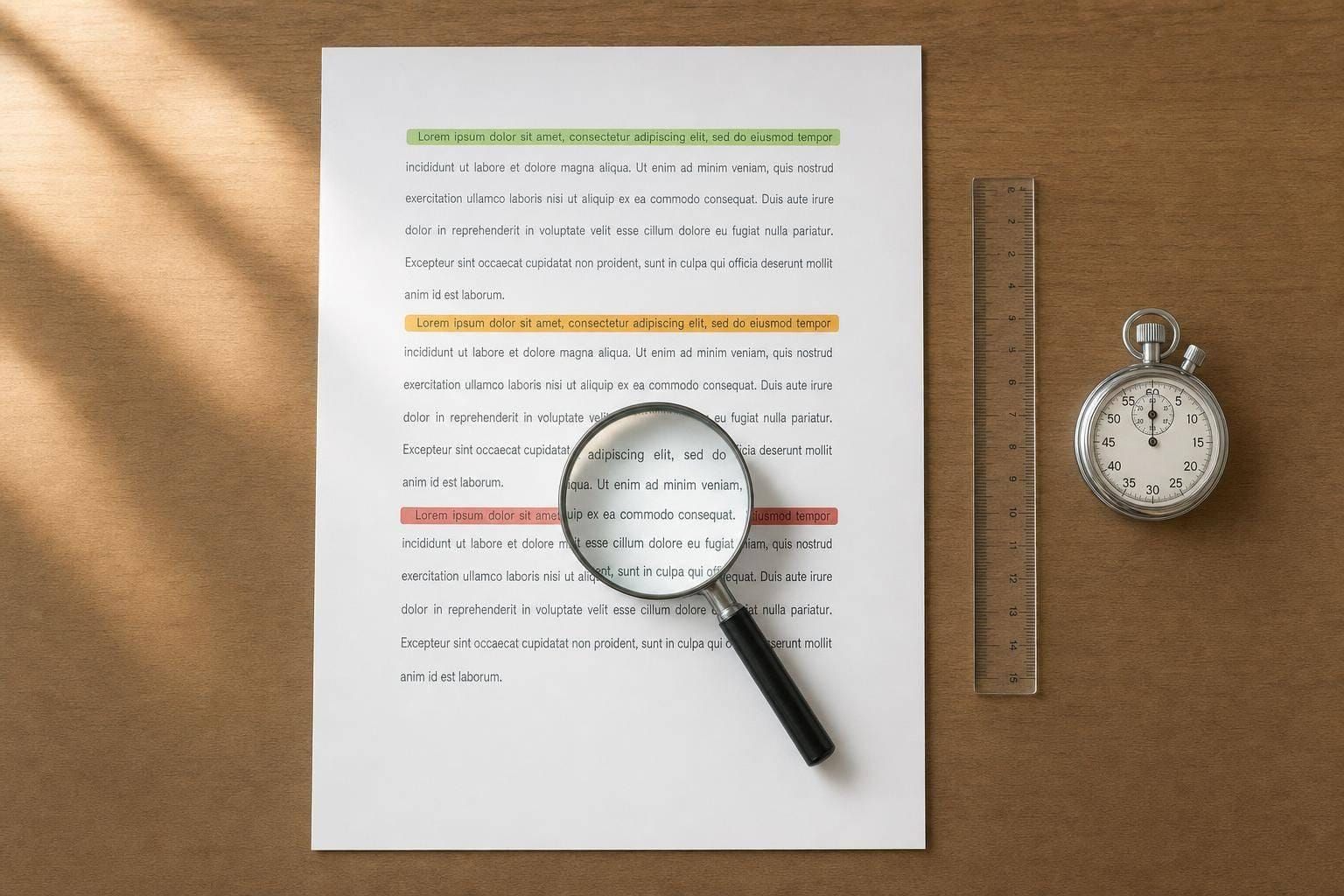
A good readability checker does more than assign a score. It helps you understand why a passage feels smooth, confusing, dense, or tiring to read. By measuring sentence length, word complexity, syllables, and other text patterns, this tool gives a clearer picture of how accessible your writing is.
What This Tool Measures
You can paste in English text and instantly review core statistics such as sentences, words, characters, complex words, and average sentence length. The tool also calculates trusted formulas like Flesch Reading Ease, Flesch-Kincaid Grade Level, Gunning Fog, SMOG, and Coleman-Liau. When a sample is too short for one of these formulas, it explains that clearly instead of showing a shaky result.
Why Clarity Matters
A reliable readability checker is especially helpful for web content, business communication, educational material, and editing workflows. Beyond scores, this tool highlights passive voice where possible, points out long sentences, and flags wording patterns that may reduce clarity. That kind of feedback is useful because readers don't experience writing as a formula—they experience it as effort.
Practical Feedback You Can Use
Instead of vague advice, the tool focuses on specific improvements: shorten long sentences, swap overly complex words, and break up bulky paragraphs. The result is writing that's easier to follow and more effective for real people.
FAQs
How accurate are the readability scores?
The scores are based on widely recognized readability formulas that use measurable features like sentence length, syllables, word complexity, and character count. That makes them useful for comparing drafts and spotting trends in difficulty. Still, no formula fully understands tone, audience knowledge, or context, so the best approach is to use the scores as guidance alongside the tool's clarity suggestions.
Why would the tool skip or flag certain formulas?
Some formulas need a minimum amount of text to produce a score that's worth trusting. For example, very short samples can distort sentence averages or underestimate difficult wording. When that happens, the tool should show a plain-language note explaining that the sample is too short, which is far more honest than presenting a number that looks precise but isn't reliable.
Can this help improve business, academic, or web writing?
Yes. A readability checker is useful anywhere clarity matters. For website copy, it helps keep content easy to scan and understand. In business writing, it can reduce confusion and make documents more direct. For academic drafts, it can highlight long sentences and dense passages that may need simplification, even when the subject itself is complex.