How to Handle Groupthink in Focus Groups
Reduce bias in focus groups: collect private answers first, use silent reflection, balance participation, and compare changes.

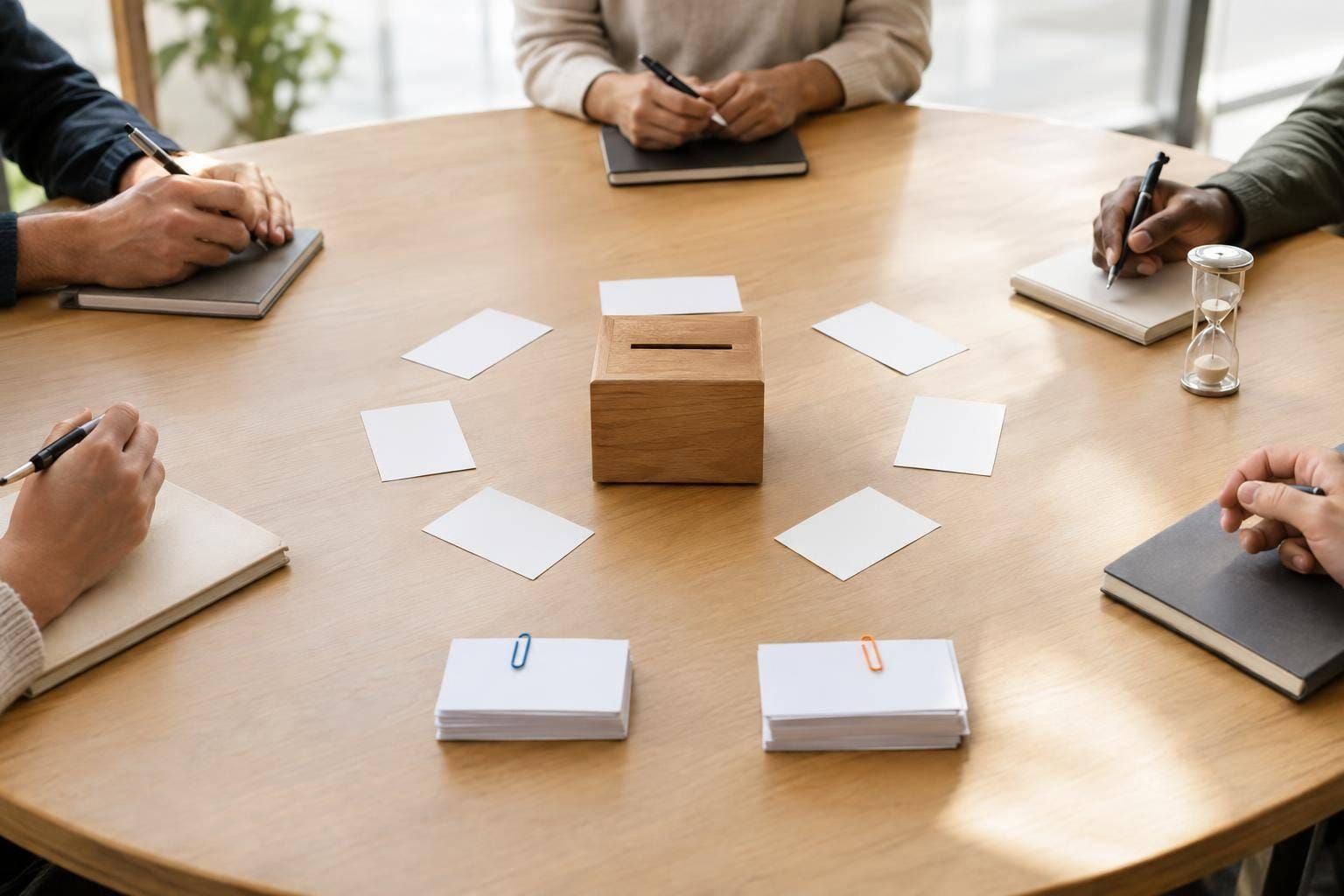
I reduce groupthink by collecting private answers before anyone speaks. A 2–3-minute silent writing pause gives each person time to record a view before hearing the group.
From there, I follow three steps:
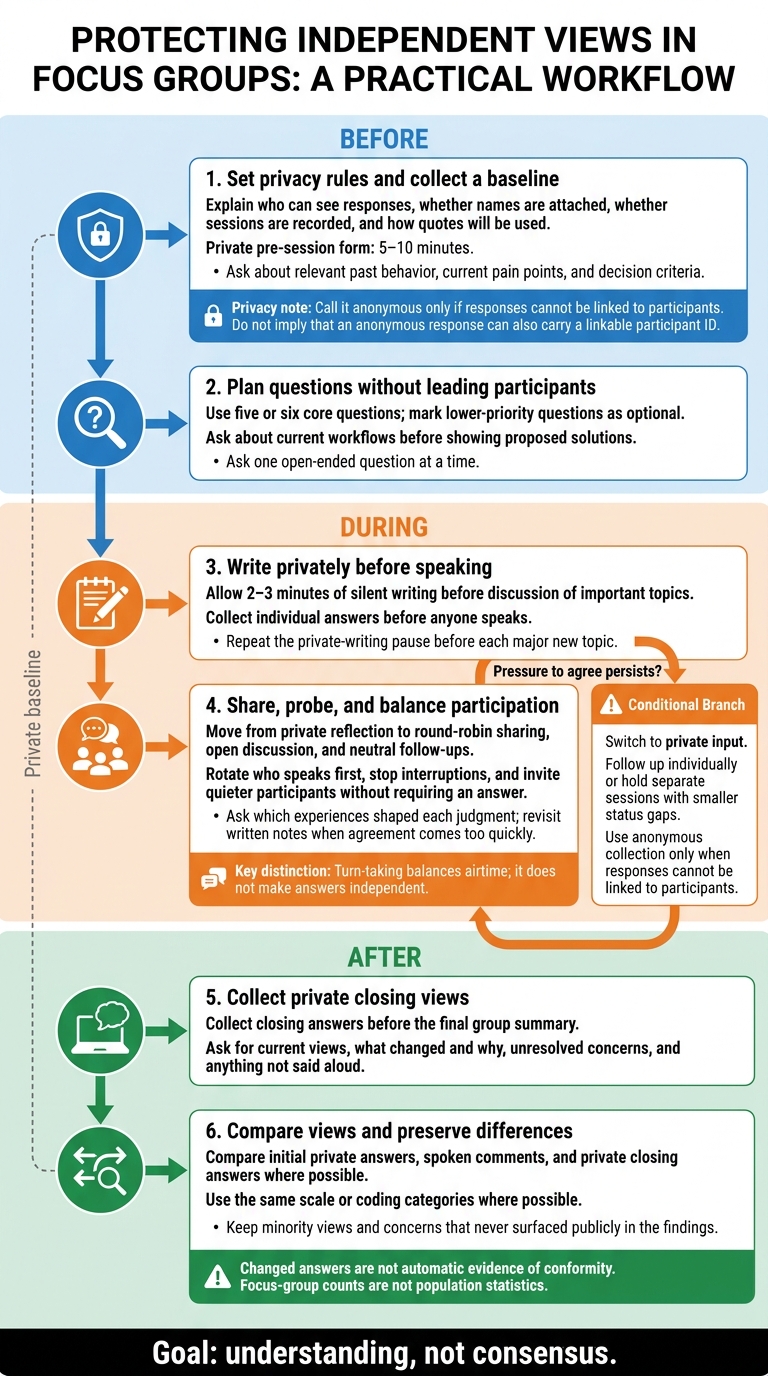
- Protect first reactions. I explain privacy limits, set ground rules, and ask about current behavior before showing solutions.
- Keep discussion open. I balance speaking time, ask neutral follow-ups, and switch to private input or separate sessions when social pressure persists.
- Compare, don’t force agreement. I collect private closing answers before the group summary, check what changed and why, and keep minority views in the findings.
My goal is <u>understanding, not consensus</u>. Agreement can be useful - but I don’t treat a changed answer as proof of pressure or group counts as population statistics.
How to Reduce Groupthink in Focus Groups
Collect Independent Views Before Discussion
Once the ground rules are set, collect each person’s first answer privately - before the group has a chance to shape it.
Save these pre-discussion answers as baseline data. Label each response with a participant ID and timestamp, and keep the original for later comparison. Treat changes in answers as evidence of discussion effects, not noise.
Use Private Forms and Silent Writing
Send a short private form that takes about 5–10 minutes to complete. Ask about relevant past behavior, current pain points, and decision criteria. Explain who can see responses, whether names are attached, whether sessions are recorded, and how quotes will be used. Call it anonymous only if responses cannot be linked to participants.
During the session, pause on important topics for 2–3 minutes of silent writing before anyone speaks. This slows the rush toward agreement and lets quieter participants put their views down first. Collect answers on paper or through an individual digital form.
Compare Ways to Gather Initial Views
Choose a method that collects independent input, then use other formats to take the discussion further. Round-robin sharing and breakouts help people discuss their views, but neither replaces private responses.
| Method | Purpose | Strengths | Limitations | Best use |
|---|---|---|---|---|
| Private pre-session form | Gather independent views | Gives people time to reflect and creates a baseline | Responses may be incomplete; privacy depends on access controls | Sensitive topics and behavior histories |
| Silent writing | Collect individual reactions | Limits influence from dominant speakers | Requires reading and writing access; answers may be brief | Immediate reactions to concepts or workflows |
| Round-robin sharing | Structure public sharing | Gives everyone a turn after private reflection | Earlier speakers may influence later answers | Sharing privately recorded views |
| Anonymous polling | Collect individual ratings or choices | Shows how views are distributed | Responses must be unlinkable; ratings provide little explanation | Checking apparent agreement |
| Breakout discussions | Discuss views in smaller groups | Gives smaller groups space to talk after initial views are collected | People may still conform within subgroups | Discussing differences found in private responses |
Use ratings to guide follow-up, not to replace qualitative discussion. Hide poll results until everyone has responded, then ask what shaped each rating. During analysis, compare private answers with spoken comments - including concerns that never came up publicly. Check later agreement against the private baseline to assess whether it reflects people’s views or group pressure.
sbb-itb-124fdbf
Plan the Session and Question Order
After recording participants’ private baseline views, plan the session so group discussion doesn’t replace them. A controlled sequence slows social pressure and keeps first answers visible.
Limit the moderator guide to five or six core questions, leaving time for probes and reflection. Flag optional questions to drop if time runs short. Cover the same core topics across groups, but leave room to follow relevant surprises rather than sticking to a rigid script.
Move From Private Reflection to Group Sharing
Start with introductions and ground rules, then an easy opening question. Move through private reflection, round-robin sharing, open discussion, neutral follow-ups, and a final private reflection. Before each major new topic, add a short pause for silent writing. Rotate who speaks first, stop interruptions, and invite quieter participants to share without requiring an answer.
Wait several seconds before rephrasing a question. If time gets tight, cut lower-priority items rather than rushing. This sequence protects early views before the moderator moves to stricter turn-taking.
Ask About Current Workflows Before Showing Solutions
Start with what participants do now, so the prototype doesn’t steer their account too early. Ask about the last time they completed the task: the steps they took, tools they used, workarounds, delays, and outcomes. Then ask what frustrated them or worked well.
Only show proposed interfaces afterward, so the solution doesn’t frame their account of current behavior. Ask one open-ended question at a time. Avoid double-barreled questions that ask about two things at once.
Check Agreement With Neutral Follow-Ups
Fast consensus needs a probe, not a vote of confidence. Otherwise, quick agreement can harden into false consensus. Ask which specific experiences shaped participants’ judgments and whether they reached similar conclusions for different reasons. Invite contrasting first reactions without pushing anyone to disagree. When agreement comes too quickly, revisit the written notes.
Balance Participation Without Pushing for Consensus
If pressure to agree continues after neutral follow-ups, change how people participate rather than pushing for consensus.
Redirect Dominant Speakers
Address the participation pattern, not the person. Look for interruptions, the same person answering first, or participants checking one speaker’s reaction before responding. Acknowledge the contribution, then give someone else the floor. Avoid blame, and don’t frame agreement as the preferred answer.
Distinguish between what you observed and what you inferred. If hierarchy keeps people quiet, gather private input, follow up individually, or hold separate sessions with smaller status gaps. Don’t invent opposing positions to force disagreement.
Change Formats When Pressure to Agree Persists
Change the format when invitations alone don’t work. Base your choice on the pressure you observe. Don’t keep an open discussion going just to get everyone to appear to agree.
| Format | When to use it | Moderation benefit | Conformity risk | Warning signs to switch |
|---|---|---|---|---|
| Open discussion | Discussing shared experiences and reactions | Shows how people interact and interpret things differently | Early speakers can anchor later answers | Interruptions, dismissed dissent, agreement without detail |
| Structured turn-taking | Airtime is uneven | Gives each person a chance to respond | Later speakers hear earlier answers, so responses aren’t independent | Echoed answers or deference to a senior participant |
| Anonymous collection | Topics are sensitive or status differences are strong | Reduces fear of judgment | Poorly designed tools can expose identities | Participants question traceability or hesitate to submit |
Turn-taking balances airtime, but it doesn’t make answers independent. Use anonymous collection only when responses can’t be linked to participants.
Collect Final Views and Report Differences
Use closing responses to check against the baseline, not to reach a final group verdict.
Collect private closing responses before the final group summary. Ask for participants’ current views, what changed and why, unresolved concerns, and anything they didn’t say aloud. Where possible, compare these with initial responses using the same scale or coding categories.
Treat changed answers as new information, not automatic conformity. Keep minority views in the report and note signs of possible influence: delayed agreement, hedging, laughter, visible discomfort, or private disagreement after public assent. Report the range of experiences, but don’t present focus-group counts as population evidence.
Conclusion: Before, During, and After Checklist
Collect private input first, discuss it second, and compare views last. This checklist helps keep early answers visible, reduce pressure to agree, and preserve differences that matter.
Before: Set ground rules, collect private first responses, and leave time for every participant to share an initial answer.
During: Use silent writing, give participants balanced speaking time, and ask what’s behind each view. Redirect long answers, and keep your tone and body language neutral.
After: Compare private first responses with spoken comments and closing notes. Separate views people held before the discussion from those shaped by it. Keep meaningful differences visible, especially when they point to a usability barrier.
Goal: understanding, not consensus. Strong UX findings explain what people experienced, the context, and why their needs differ.
FAQs
How can I distinguish groupthink from genuine agreement?
Look for individual, well-reasoned explanations, not participants repeating one another. Genuine agreement comes with people explaining how they thought through the design, made decisions, and interacted with it. Groupthink often appears as vague explanations or hesitant, similar responses that echo earlier comments.
Before the group discussion, use silent writing exercises or private surveys to gather individual views and give participants space to form their own opinions.
How can I adapt silent writing for accessibility needs?
Offer flexible formats based on individual needs. Participants who find standard writing difficult can sketch, point to elements, or share feedback verbally - whichever feels more comfortable.
Share preparation details and accommodation options early so participants can check compatibility with assistive technologies. These options help remove barriers so everyone can contribute before the group discussion begins.
When should I replace a focus group with individual interviews?
Use individual interviews instead of focus groups when you need to avoid group influence or study user behavior in more depth and privacy. They’re better suited to discovery research into personal motivations, pain points, and mental models. Without a group present, participants face less pressure to conform or give socially acceptable answers.
One-on-one sessions also give participants dedicated space to share honest feedback about their experiences or test an interface’s usability and clarity.